Working On: learning something new!
and being bad at it for a while

The origin of the spinning wheel is, apparently, a highly contested topic, with some scholars claiming that the technology was invented in India as early as 500 AD, while others say it is more likely to have appeared in China around 1000 AD. (I’m quoting here from an article about charkhas in SpinOff magazine, but I did verify this information separately as well.)
For the first 500-1000 years, spinning wheels were of the spindle variety, featuring a drive wheel that was turned with one hand while the fiber was drawn out off the tip of a spindle with the other hand. These types of wheels are often familiar to us as a Great Wheel or Walking Wheel. According to the Encyclopedia Britannica, the treadle and flyer mechanisms then appeared in the early 16th century, and this assembly is still the most common amongst modern spinning wheels.
National Museums Scotland has a really lovely blog post showcasing some of the different kinds of spinning wheels in their collection (and describe their differences), as well as some historic photographs of spinners in Scotland. There are also a few excellent examples of a type of spinning wheel that was unknown to me until I bought one - the castle spinning wheel.
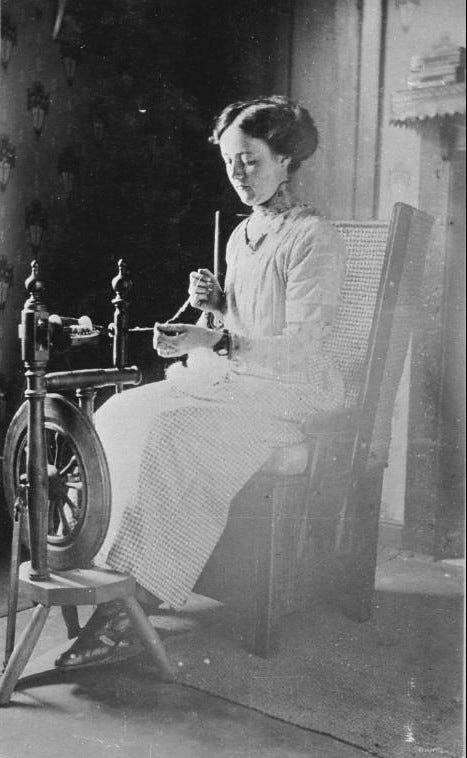
This kind of wheel, seen in the above photograph, has the drive wheel positioned directly underneath the mother-of-all, making the wheel extremely compact and portable. They are also sometimes called upright wheels or parlor wheels (allegedly their small size made them perfect for use in a small Victorian parlor).
Apparently they were also popular as decorative items in the middle of the 20th-century, and many small castle wheels were produced in Eastern Europe and exported for this purpose (according to my research in the ever-fruitful Ravelry forums). My lovely little castle wheel, purchased at an antique fair for 25 pounds, seems to have been one of these, probably Czech or German.
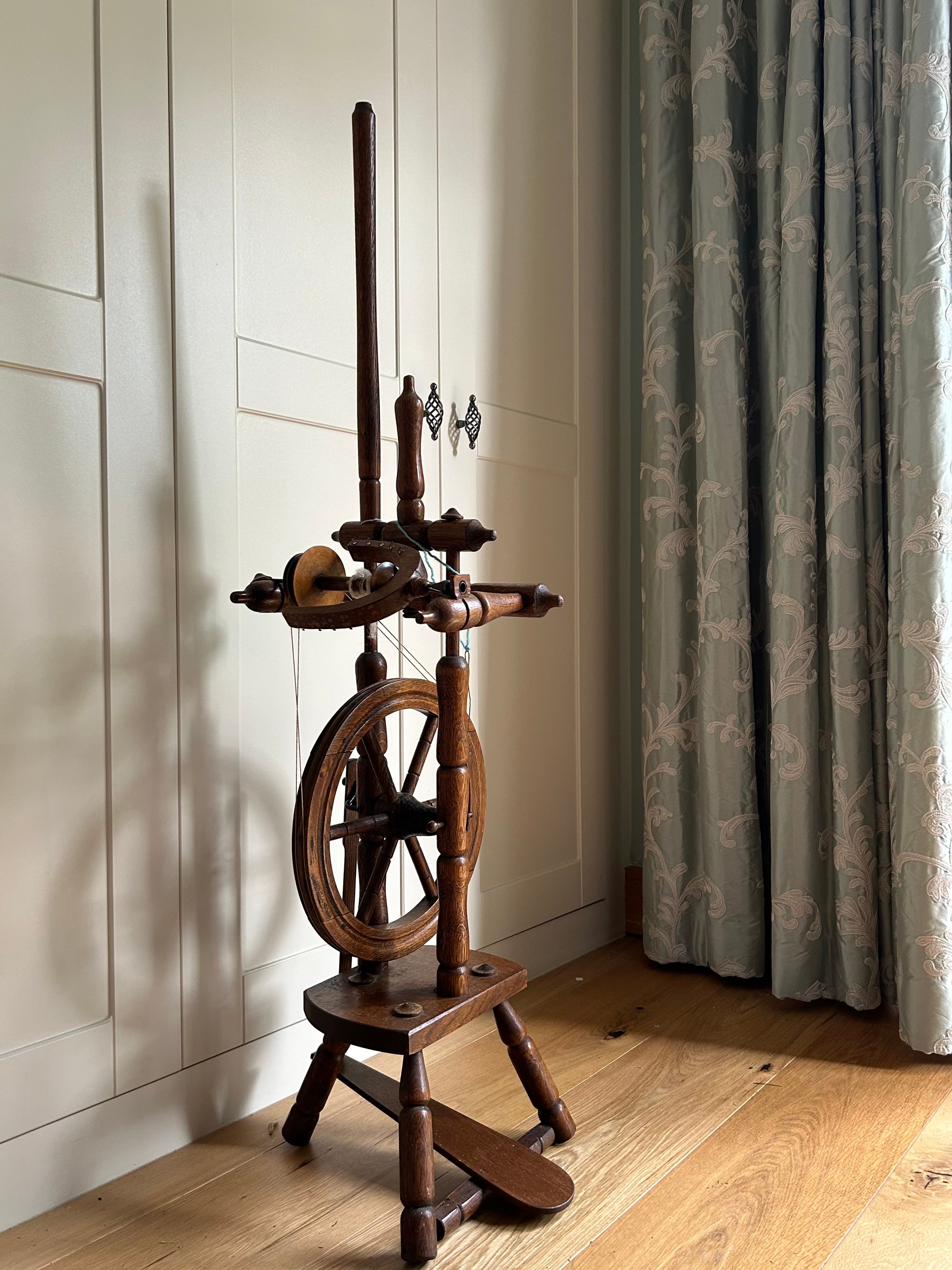
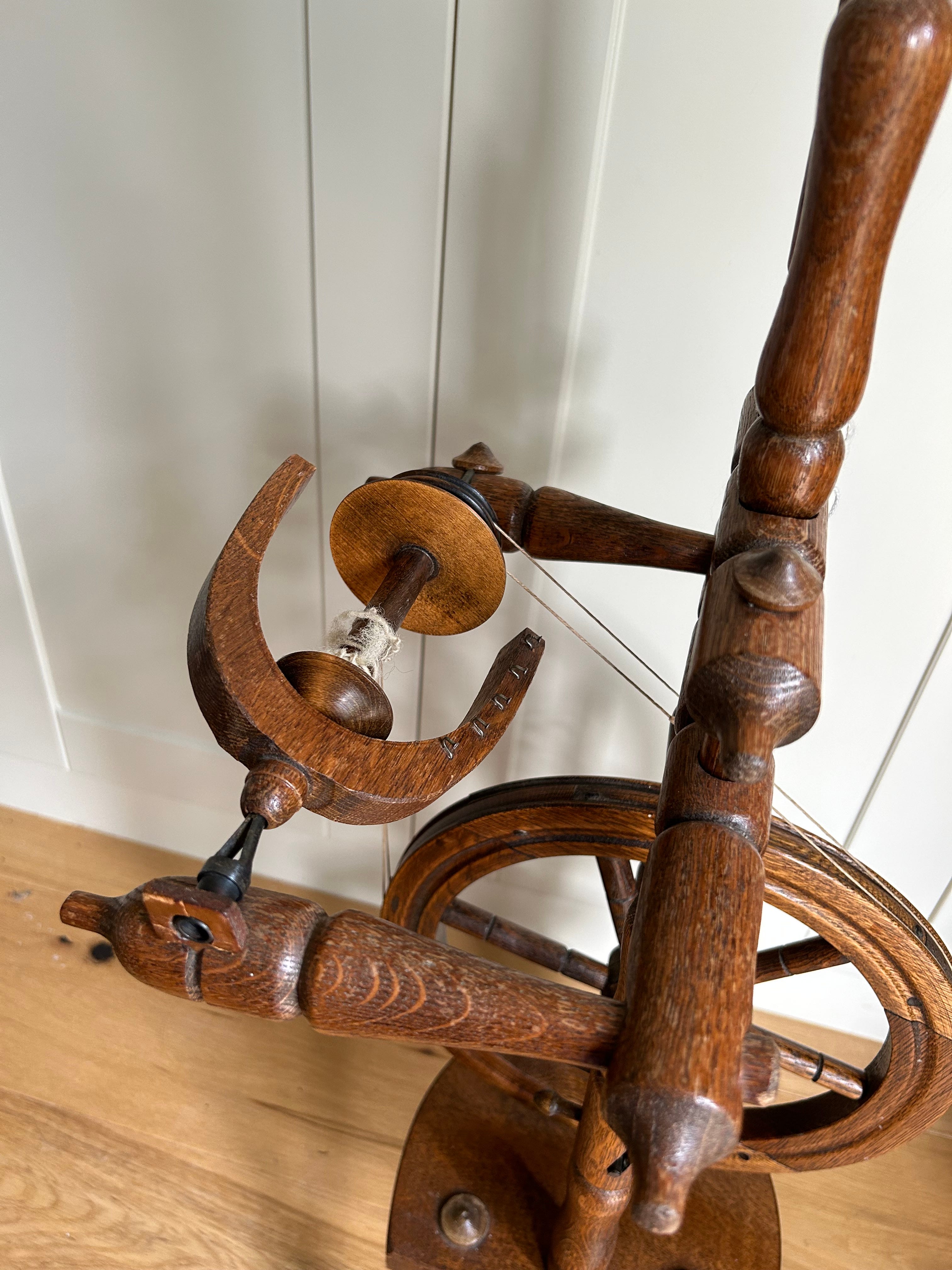
Somewhat miraculously, the thing actually works, too. It’s in surprisingly good nick, with a functional flyer, a bobbin, an orifice hook and even a distaff on the top. It is easy to set up and tweaking the tension is as simple as turning a screw. And of course it’s incredibly cute.
It does have one slightly-significant issue, which is that the axle slips inside the hub of the wheel. At the moment, I’m solving this problem with a toothpick shim, and I think I’ll probably continue to do that. There are various permanent fixes out there, involving drills and machines and pins, but I don’t mind little quirks in my tools, and if I have to re-shim the axle every once in a while, that’s fine by me. (I also, rather notoriously these days, drive a 19-year-old car with no working interior lights, a broken glove box, peeling upholstery, and a window that has to be rolled up using a pencil, so owning very idiosyncratic devices is simply my custom and habit.) Make do and mend, I say.
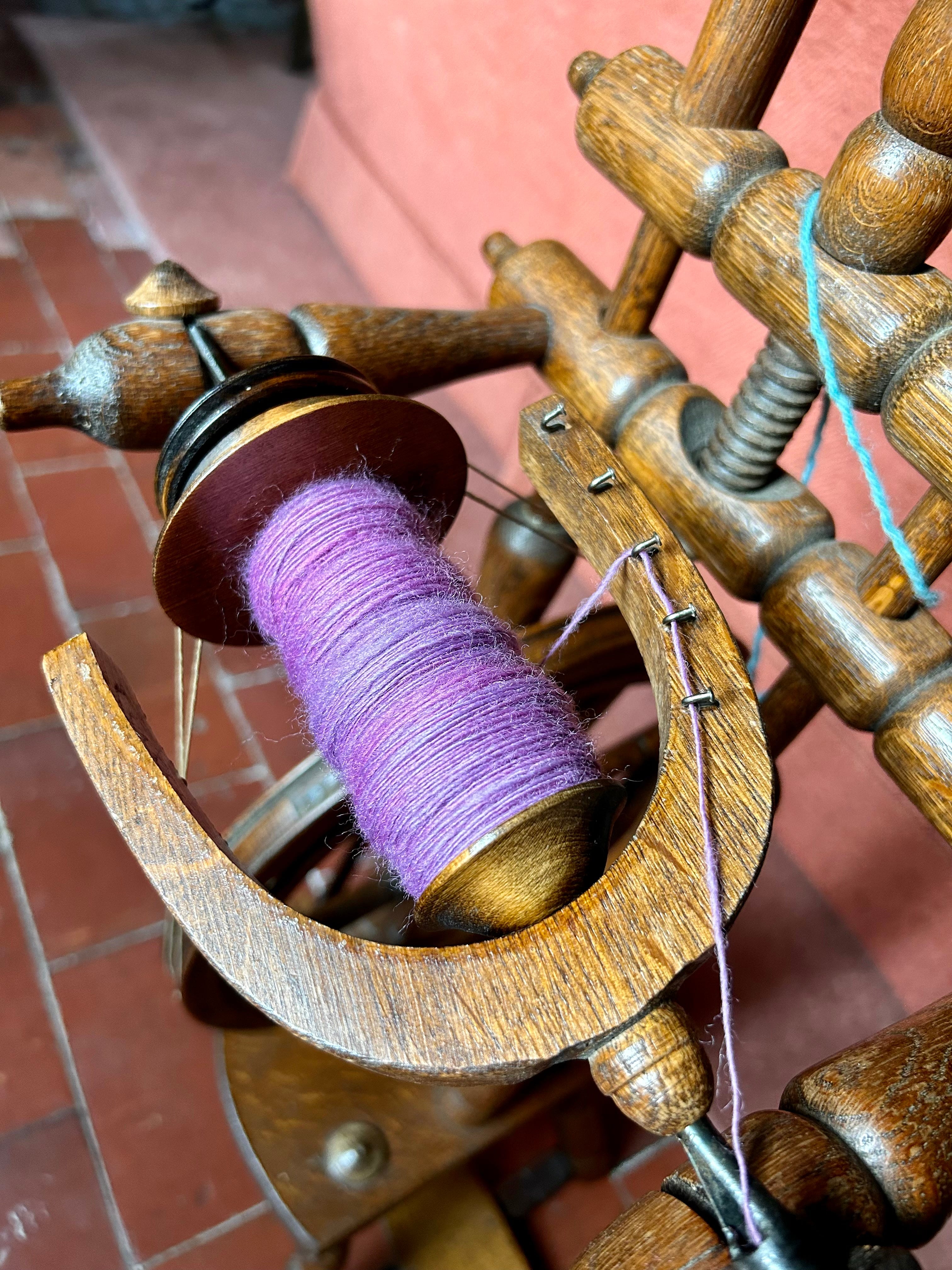
With my quick fix in place, I’ve managed to spin one bobbin-full, or nearly 2 ounces of fiber, on my little spinning wheel. I am astonished at how much faster it is than spinning on a drop spindle, even at my slow beginner’s pace. I was also very surprised by how hard it was to get the hang of it.
Because I’ve been spinning on a drop spindle for a decade-ish, I thought I’d pick up wheel-spinning quickly. However, I was quickly disabused of this notion, as I struggled just to treadle consistently and then, once I was working with the fiber, to move my hands and feet at the same time. The wheel started, stopped, went backwards. I spun yarn that was thick, then thread-fine, then my fiber drifted apart altogether. Hours went by, seemingly without improvement.
And then, slowly, I noticed that I was spinning for longer stretches of time. The thread was more consistent. I didn’t feel quite so frazzled anymore - in fact, I was relaxing into the rhythm.
It’s been a long time since I have tried to learn to do something that was as purely physical as this. There was no way to intellectualize what I needed to do to spin good yarn, I simply had to feel my way into it. Practice was the only way forward - I had to simply go through the motions, again and again, until somehow, I could do it correctly. It felt like I was getting nowhere, and then at some point I was refining my technique, treadling more smoothly, drafting the right amount of fiber. It felt like being a child again - like learning to write, or ride a bike, or jump rope.
It’s good to be bad at something. (For one thing, it keeps you humble.) The human brain loves to learn, and a challenge is particularly good for it. I felt stretched by the process of learning to spin on a wheel - like, I think my brain grew. And I still have so far to go! I am still bad at wheel-spinning, and there is so much room for improvement, and I’m so excited about it. All I want to do when I wake up in the morning is sit down at my little spinning wheel, and be bad at spinning, and maybe get better at it.
Plying is the next step, and some cardboard storage bobbins are already en route to me for this purpose. I purchased a set of long straight knitting needles at a charity shop today and have plans to DIY a cardboard-box lazy kate (like this). It’s very satisfying to me that I have spent approximately £30 and some elbow grease on this whole enterprise - new or even used spinning wheels are typically upwards of $400, which is simply not in my budget right now (or maybe ever, to be honest). The inaccessibility of textile craft to many people, because of cost and other factors, is something that I’ve been thinking about a lot recently, so I’m chuffed that I’ve proven you can do this relatively cheaply - and sustainably - if you’re willing to put up with some idiosyncrasy in your tools.

Work on the hand-sewn dress continues, and is actually going faster than I’d expected. When I went to put together an Instagram reel about the project, I was shocked to realize that in the 11 days since I cut out the fabric, I have sewn the entirety of the yoke, the button bands, and completely attached the collar - I’ve moved onto attaching the sleeves now, and then I have to sew the side seams, finish all of those seams, sew the buttonholes, attach the buttons and hem the dress. And that’s it! I myself am amazed.
In spite of my commitment to hand-stitching this summer, I must confess that I did also buy a vintage sewing machine. It’s a hand-crank Singer 99k, was made in 1924, and cost £48. I couldn’t say no! Actually, I did say no the first time, thought about it for four days, and then went back for it. It’s in really good condition, seems to work beautifully, and deserved to be used and loved instead of sitting dusty on the attic floor of an antique shop. (I will certainly have much more to say about this in next week’s newsletter!)

This week I started listening to the new season of Articles of Interest, one of my favorite podcasts. I’m not sure that this season is as good as American Ivy was, but I’ve been enjoying listening to it and will always recommend this show to anyone who is interested in clothes. The producer, Avery Trufelman really likes to nerd out over quite niche things and I, for one, hugely appreciate it. The first episode is all about the Clueless closet and was a lot of fun.
I’ve been spending quite a lot of time this June looking at wildflowers and meadows and sitting in the sun, and for some reason it’s got me thinking about one of my favorite literary adaptations - Merchant & Ivory’s 1985 A Room With a View. Helena Bonham Carter is absolutely flawless in it, and it’s the perfect lush, languid summer film. The internet tells me it’s streaming on YouTube.
Well, that’s all from me this week; I’ll be back next Tuesday with more about vintage textile tools and progress reports on my current projects. If you enjoyed reading this newsletter, please feel free to share with a friend or on social media. Talk to you soon!